
Over the past few weeks I’ve covered Basic Channel, Rhythm & Sound and Main Street: three projects at the absolute pinnacle of their respective musical genres.
Now we’ll take a look at the men behind the music, starting with Mark Ernestus.
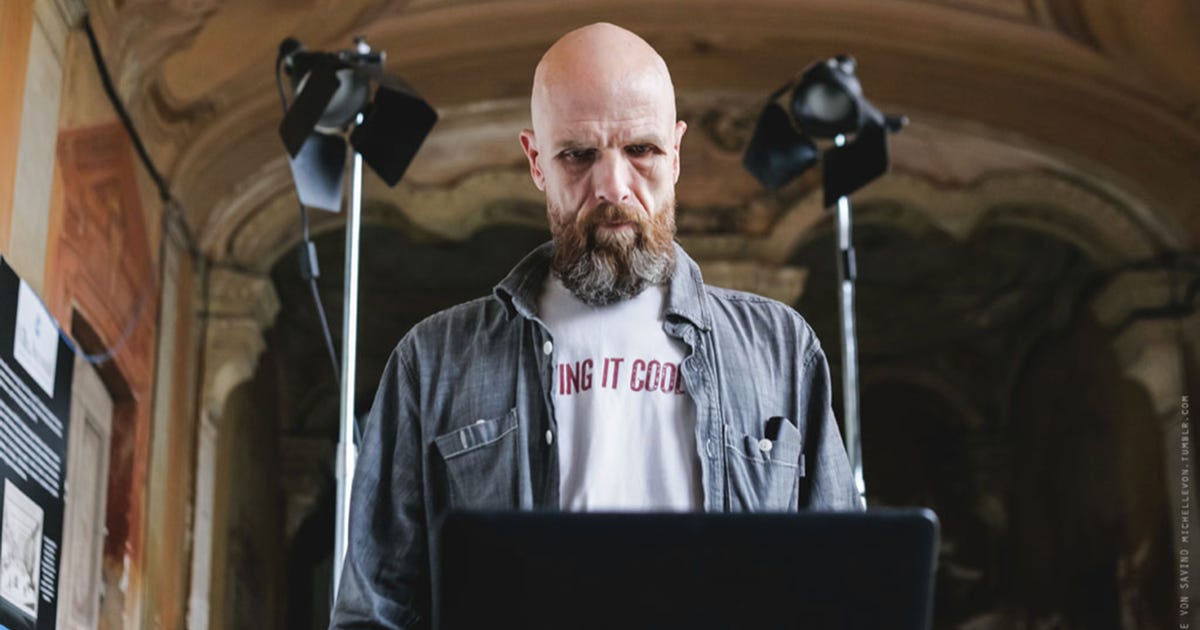
Both Ernestus and his production partner Moritz von Oswald have been notorious over the years for their aversion to public statements and profile building, preferring instead to let their music do the talking.
In fact they pioneered the minimalist, anonymous white label culture that in many ways continues to define serious club music. For many years nobody knew who was behind the era-defining rhythms they were unleashing on the world.
In a rare interview with the Wire from 2010, Ernestus recalls:
“When I first got involved with producing I remember thinking for myself, what is it you try to achieve, you know. Because you definitely don’t want your face or your name all over the place. And you’re shy, you’d rather be invisible. I realise that I really loved the idea to have my genetic code in the genetic code of music. That would be a huge goal, that would be the biggest achievement in a way”
I think we can say with absolute certainty that Ernestus has achieved his goal. His DNA has infused every area of electronic music and he is a foundation stone of the entire culture, the Berlin scene in particular.
As founder of the city’s legendary Hardwax record store (Tip!), which opened in 1989, he played a critical role in establishing the Berlin-Detroit nexus. By facilitating the import and distribution of Detroit techno across Europe he helped cultivate a sound that would become completely central to the continent’s musical identity.
As co-founder, alongside von Oswald, of the Dubplate & Mastering cutting house, he brought specialised club music mastering to Berlin for the first time, inspired by the high quality independent sound engineers he admired from the US and UK.
As a solo producer he’s been behind some of the most important electronic music of the past 15+ years; delivering a slew of high quality remixes, versions and collaborations with top tier artists, as well as playing a central role in one of the most compelling live acts I’ve ever seen; Ndagga Rhythm Force.
Let’s start with the versions.
VERSIONS
A few favourites for your delectation.
Tony Allen - ‘Moyege (Mark’s Disco Dub)’ (2006)
A rare disco outing for Ernestus as he expertly re-rubs a slice of afro-funk for Fela Kuti’s legendary percussionist Tony Allen.
‘Mark Ernestus meets BBC Version’ (2011)
Taken from Honest Jon’s now classic 2011 Shangaan Shake remix compilation. This beautiful, deep, rhythmic ambient workout demands serious amplification.
Mark Ernestus vs Obadikah ‘April’ (2016)
One word: Triumphant.
Calibre & DRS v Mark Ernestus ‘Bad’ (2021)
A dream collaboration for any bass music connoisseur.
Now let’s turn to Ernestus’s primary musical focus over the past 15 years.
NDAGGA
I first came across the Ndagga project back in 2015, when I picked up the Yermande and Lamb Ji 12”s by Ndagga Rhythm Force on a trip to Honest Jon’s.
I was immediately struck by the depth and richness of this music; the complexity of the rhythms and the obvious joy and passion with which they were delivered.
For the origin story of how the whole project came together, you can’t do better than listen to the man himself in this excellent recent interview from RA.
Long story short: Ernestus had become increasingly hooked on the extraordinary Mbalax polyrhythms he found in youtube clips of Sabar drummers from Senegal. His online obsession soon became a real life quest as he travelled to the country seeking out original recordings and then collaborating with some of the culture’s leading artists.
He became a founding member of Jeri-Jeri, a group formed of more than 20 Senegalese musicians whose name came from the tribe of the participating artists. In true Rhythm & Sound style, the results of these studio sessions were released as a run of 12”s, followed by two albums of original tracks and dub versions. Two standouts:
‘Ndeye Gueye’
‘Gawlo” w/ Baaba Maal
After these initial releases, the project evolved into a more focused and polished live act and was renamed Ndagga Rhythm Force in 2014, with most of the Jeri-Jeri members joining the new group.
And while the early recordings from 2011-2013 are undeniably excellent, for me the sound is truly elevated when Ernestus begins to fully flex his hi-fidelity studio chops alongside the raw Senegalese tribal drumming, creating a more minimal, polished and dub-inflected sound.
Two particular stand outs from the original Ndagga run:
Yermande (Prophet 5 Mix) (2015)
‘Lamb Ji’ (2015)
You should absolutely check out the full LP.
Then after more than a decade of honing their stagecraft, Ndagga returned in 2025 with a new long(ish) player ‘Khadim’. My choice cut:
‘Lamp Fall’
Finally, Ndagga must be understood first and foremost as a live act.
I had the absolute pleasure of attending one of their first UK gigs at Cafe Oto in (I think) 2016, which was simply one of the most perfect musical performances I’ve ever experienced. Some footage here:
I seem to remember bursting into (happy) tears at one point during the performance; it was really that good.
If you get a chance to see them live, make sure you take it.
For now, ultimate respect to Mark Ernestus.
A true giant of the culture.
Peace and love.
Rubin